
Stop Measuring PR Tactics
Why PR Measurement Keeps Missing the Mark

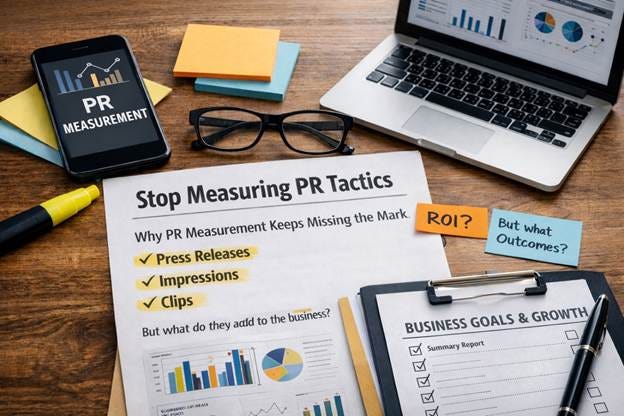
A few times a month, I get a version of the same call.
“How many press releases will you do?”
“How many feature articles should we expect?”
I understand why those questions come first. They feel concrete. They feel measurable. They also tell me exactly where things are about to go sideways.
Public relations is supposed to support business outcomes. Growth. Recruiting. Credibility. Risk reduction. Yet many organizations still measure PR using metrics that have little connection to any of those goals.
That disconnect is not accidental. It is structural.
PR does not close deals, but it shapes decisions
Sales teams rarely start from a blank slate. Prospects arrive with opinions already formed. Those opinions are shaped by what they have read, what they have searched and increasingly, what AI summaries tell them before they ever land on a website.
PR influences whether a brand feels credible or risky.
It influences how uncertainty is evaluated.
It influences which companies feel safer to engage.
By the time a sales conversation begins, PR has often already done its work. Or failed to.
When PR measurement ignores that reality, leadership underestimates its impact by default.
The first mistake is measuring activity instead of contribution
Press releases and feature articles are tools. They are not outcomes.
A press release does not equal awareness.
A feature article does not equal trust.
When PR measurement begins with volume, reporting will focus on output instead of influence. That is how teams end up defending effort rather than explaining results.
Strong media relations should be evaluated by whether it changed perception, supported decision making or reduced friction in conversations that matter.
The second mistake is treating PR like paid media
Paid media is designed for direct attribution. Public relations is designed to build credibility over time.
PR influences how buyers evaluate risk, how candidates assess employers and how partners and investors judge stability. When leaders apply paid media metrics to PR, they flatten its value into something it was never meant to be.
This is why clicks alone are a weak proxy for impact. Authority and trust signals matter far more than last-touch attribution in PR measurement.
The third mistake is reducing PR to earned media only
PR is still too often equated with media relations alone.
In reality, PR includes earned, paid, shared and owned media working together. If measurement ignores owned content and message consistency across channels, reporting is incomplete from the start.
Owned media is where interest turns into understanding. If owned content is weak, PR has less to amplify and sales has less to support conversations already underway.
The fourth mistake is choosing KPIs after execution starts
This one is costly.
Effective PR measurement starts during planning, not after coverage runs. The sequence matters.
What business outcome are we supporting?
What needs to change to support that outcome?
What can we realistically measure over time?
When KPIs are chosen after activity begins, reports justify effort instead of evaluating impact. That is not measurement. That is storytelling without accountability.
Awareness is not the problem. Poor measurement is.
Awareness is often cited as a goal. Rarely is it measured correctly.
Without baseline and follow-up studies, awareness becomes an assumption. Impressions get used as a proxy, even though exposure does not equal influence.
That does not make awareness unimportant. It means the measurement approach must match the reality of budget, tools and timelines. Otherwise, awareness becomes a word that sounds good but collapses under scrutiny.
AI search visibility changed the front end of PR measurement
Buyers now encounter brands through AI-generated answers before visiting a website. Those summaries are shaped by authority, credibility and third-party validation. All PR territory.
If PR measurement does not include how a brand appears in AI search and summaries, leaders are missing where decisions now begin.
PR, sales and AI intersect earlier than most organizations realize.
What smarter PR measurement actually looks like
Smarter PR measurement focuses on contribution to business decisions, not volume of activity.
That includes metrics like share of voice tied to growth priorities, message accuracy across channels, referral traffic that supports qualified demand, assisted influence on sales and recruiting and presence in AI-generated answers for key topics.
These metrics do not replace sales data. They explain the conditions that make sales outcomes more likely.
PR works best when it is measured the same way decisions are made.
If reporting cannot explain how communications supported growth, recruiting or trust, the issue is not the metrics themselves. It is how success was defined.
Stop Guessing What PR Is Doing for Your Business
Public relations should not be reported as activity. It should be measured as influence.
At TrizCom PR, we help leadership teams define success before campaigns launch by aligning communications goals with revenue, recruiting, credibility and how decisions are actually made today, including through search and AI-driven discovery.
If your PR reports do not clearly show how communications support growth, trust and demand, it may be time to reset how success is defined.
Let TrizCom PR help you move from outputs to outcomes and turn your story into a measurable advantage.
Stay warm –
Jo
Every organization has a story.
The question is whether it is helping or hurting the business when it matters most.

About the Author:
Jo Trizila – Founder & CEO of TrizCom PR
Jo Trizila is the founder and CEO of TrizCom PR, a leading Dallas-based public relations firm known for delivering strategic communications that drive business growth and enhance brand reputations as well as Pitch PR, a press release distribution agency. With over 25 years of experience in PR and marketing, Jo has helped countless organizations navigate complex communication challenges, ranging from crisis management to brand storytelling. Under her leadership, TrizCom PR has earned recognition for its results-driven approach, combining traditional and integrated digital strategies to deliver impactful, measurable outcomes for clients across various industries, including healthcare, technology and nonprofit sectors. Jo is passionate about helping businesses amplify their voices and connect with audiences meaningfully. Her hands-on approach and commitment to excellence have established TrizCom PR as a trusted partner for companies seeking to elevate their brand and achieve lasting success. Contact Jo at jo@TrizCom.com.